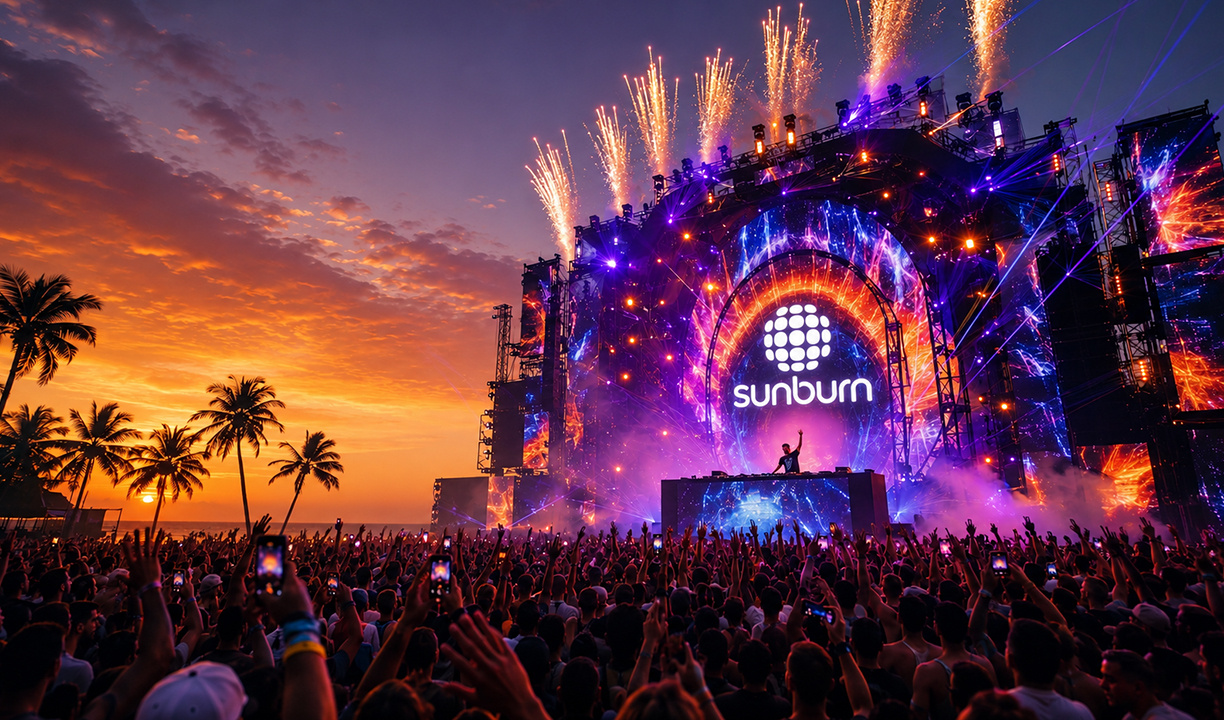
Sunburn's Rise in India: Music, Marketing & Youth Culture

Sunburn became India's biggest electronic dance music festival by combining early timing, aggressive scale, and a genre that spoke to a generation without needing a shared language. Founded in 2007 on a Goan beach with a few thousand attendees, it grew into an event drawing hundreds of thousands of fans annually, backed by international headliners and a business model built for expansion. Understanding how it got there says as much about India's youth culture over the past two decades as it does about festival marketing itself.
A Small Beach Party With Big Timing
Sunburn began in December 2007 at Candolim Beach in Vagator, Goa, organized by Percept Ltd under the direction of entrepreneur Shailendra Singh. The first edition ran for two days, featured around three dozen artists across three stages, and drew an estimated six thousand attendees. International names like Carl Cox and John "00" Fleming headlined, giving the fledgling event instant credibility with the small but growing Indian audience already familiar with trance and house music through Goa's underground party scene.
What made the timing significant was the state of India's entertainment options at that moment. For a young, urban population coming of age with reliable internet access and growing exposure to global pop culture, choices were still limited to cricket, Bollywood cinema, and shopping malls. Electronic music, largely without lyrics, offered something different. It did not require English fluency, regional language comfort, or familiarity with any particular film industry. A beat worked the same way in Delhi as it did in Chennai, and that universality became one of Sunburn's quiet strategic advantages from day one.
Goa itself mattered too. The state already carried decades of association with beach parties and electronic music through its trance scene, so hosting a formal, ticketed festival there gave Sunburn an authentic backdrop rather than a manufactured one. Early attendees were not being introduced to electronic music and beach culture separately. They were experiencing something that already felt native to the location.
Scaling From Festival to Franchise
Sunburn's growth from a single annual event into a year round brand is really the story of how Percept turned a festival into a franchise. Rather than treating Sunburn as one date on the calendar, the company began layering multiple formats onto the same name throughout the year.
In 2011, Sunburn Arena launched in Mumbai with Avicii headlining, bringing the brand into an indoor, city based format outside its Goa home base. The following year brought Sunburn City Festival, Sunburn Campus, and Sunburn Reload, each targeting a slightly different audience segment, from college students to urban nightlife regulars. That same year, Sunburn also made its first move abroad with an edition in Colombo, later followed by events in Kathmandu, Dubai, Muscat, and Melbourne.
This multi-format approach is a useful example of brand extension in the live events industry, where a single recognizable name is applied across several distinct products to multiply revenue streams and audience touchpoints without having to build new brand equity from scratch each time. For Sunburn, it meant a college student in a tier two city could experience a smaller Sunburn Campus event without ever needing to travel to Goa, while still feeling connected to the larger festival identity.
By the time Sunburn reached its tenth anniversary around 2016 and 2017, the numbers reflected just how far the franchise model had taken it. Widely reported figures at the time put global attendance across all Sunburn formats at roughly 850,000, with a compound annual growth rate near 90 percent over the preceding four years. Sponsorship revenue for that financial year was reported at around 100 crore rupees, and organizers publicly discussed ambitions to nearly double attendance further in the years that followed.
The Marketing Behind the Movement
Sunburn's marketing success rested on a few consistent principles rather than any single viral moment. The festival positioned itself early as an aspirational lifestyle brand rather than simply a concert series, which meant its messaging focused as much on identity and belonging as it did on the lineup of artists performing.
International headliners played a central role in this positioning. Over the years, Sunburn brought artists including Armin van Buuren, Martin Garrix, David Guetta, Hardwell, Axwell, and eventually Skrillex and Peggy Gou to Indian stages, often marking those artists' first or among their first India appearances. Each booking functioned as both a draw for ticket sales and a marketing signal that India could host the same caliber of talent as any major global festival market.
Social media and digital content amplified this further. Sunburn invested heavily in live streaming and online video content well before it became standard industry practice, with organizers publicly targeting tens of millions of online views to extend the festival's reach far beyond the physical attendee count. This digital layer meant that even fans who never bought a ticket became part of the audience, sharing clips and building anticipation for the next edition.
The brand also leaned into its own scale as a marketing asset. Industry reports from the mid-2010s described Sunburn's production values and attendance as comparable to some of the world's largest electronic music festivals, and that comparison became a recurring talking point in how the festival presented itself to sponsors, artists, and fans alike. Being described in the same breath as the biggest names in global EDM gave Indian audiences a sense that their local festival scene had genuinely arrived on the world stage.
Riding the Youth Explosion
None of this growth happens without India's demographic and cultural shifts over the same period. A young population, rising disposable income among urban millennials, and expanding smartphone and internet penetration created exactly the conditions a festival brand needs to scale quickly. As streaming platforms and video sharing sites gave Indian listeners direct access to global music trends, electronic dance music stopped being a niche import and became a genre with a genuine domestic fan base.
Sunburn positioned itself at the center of that shift by treating the festival as more than a music event. Adventure sports activations, flea markets, gourmet food stalls, and immersive stage production turned each edition into a multi-day lifestyle experience rather than a single evening of concerts. This broadened the audience beyond hardcore electronic music fans to include people primarily drawn by the overall festival atmosphere, social experience, and content opportunities for their own social media presence.
The following table summarizes some of the major shifts in Sunburn's format and scale over its history, illustrating how the festival evolved alongside its audience.
Period | Key Development | Approximate Scale |
|---|---|---|
2007 | Debut at Candolim Beach, Goa | Around 6,000 attendees |
2011 to 2012 | Launch of Arena, City Festival, Campus, Reload, and international editions | Rapid multi-format expansion |
2016 to 2017 | Tenth anniversary, franchise model matures | Roughly 850,000 attendees across formats |
2023 | Four-day format returns to Vagator, Goa | Over 150,000 attendees |
2024 | Relocation to Dhargalim, North Goa after regulatory disputes | Around 300,000 attendees |
Growth Was Not Without Friction
Sunburn's expansion has not been a straight line upward, and understanding the obstacles along the way gives a more complete picture of how the brand actually operates. Regulatory hurdles have surfaced repeatedly, including protests during the festival's years in Pune and, more recently, strong local opposition in 2024 when organizers considered relocating the flagship Goa edition to villages in South Goa. Residents and activists raised concerns about noise, environmental impact, and inadequate community consultation, ultimately pushing the event back to North Goa instead.
The festival has also had to navigate periodic safety and substance related controversies common to large scale dance music events worldwide, prompting organizers to introduce awareness campaigns around road safety and drug related risks alongside the entertainment programming. The COVID-19 pandemic presented its own disruption, forcing Sunburn to experiment with virtual and hybrid formats and later operate under reduced capacity limits before returning to full scale events.
These challenges are worth mentioning not to diminish the festival's success but to explain it more honestly. A brand that scales as quickly as Sunburn did inevitably runs into friction with local communities, regulators, and shifting public health circumstances. How an organizer responds to that friction, whether by relocating, adapting formats, or investing in awareness campaigns, often says as much about long-term brand resilience as the growth numbers themselves.
What Sunburn's Story Reveals About Indian Live Entertainment
Sunburn's trajectory offers a useful case study for anyone trying to understand how live entertainment brands grow in India. It shows the value of arriving early in an emerging genre, the power of pairing international talent with local cultural context, and the importance of extending a single brand across multiple formats rather than relying on one annual event to carry an entire business.
It also reflects a broader truth about Indian youth culture over the last two decades. As digital access expanded and global music trends became instantly available, audiences increasingly wanted shared, in-person experiences that matched what they were already discovering online. Sunburn did not create that appetite on its own, but it recognized it early and built the infrastructure, both physical and digital, to meet it at scale.
Quick Reference Summary
Sunburn launched in 2007 in Goa, founded by Shailendra Singh of Percept Ltd, with around 6,000 attendees at its debut.
The festival's genre, electronic dance music, helped it cross India's linguistic and regional divides.
Percept expanded Sunburn into a year round franchise through formats like Arena, Campus, Reload, and City Festival.
International headliners and heavy digital content investment powered the brand's marketing.
By its tenth year, Sunburn's global attendance across formats reportedly reached around 850,000.
Regulatory disputes, safety concerns, and the pandemic tested the brand's resilience along the way.
Sunburn's growth mirrors India's broader youth demographic and digital access boom.
Key Definitions
Electronic Dance Music (EDM): A broad genre of electronic music built around danceable rhythms, often performed live by DJs, and generally without the reliance on lyrics that defines most mainstream music genres.
Brand extension: A marketing strategy where an established brand name is applied to new products or formats to expand reach without building a new identity from scratch.
Festival franchise model: An approach where a single festival brand operates multiple recurring event formats across different cities, audiences, or times of year under one unified identity.
Related Concepts at a Glance
India's smartphone and internet growth enabled direct audience access to global music trends.
International headliner bookings functioned as both entertainment draws and marketing signals of scale.
Regulatory and community relations shaped where and how the festival could physically operate.
Digital content and live streaming extended the festival's audience well beyond ticket holders.
Demographic shifts among urban Indian youth created the underlying demand Sunburn scaled into.
Frequently Asked Questions
When and where did Sunburn start?
Sunburn began in December 2007 at Candolim Beach in Vagator, Goa, as a two-day electronic music event with around 6,000 attendees.
Why did electronic music resonate so strongly in India?
Its largely lyric-free format allowed it to cross India's many regional and linguistic boundaries, giving it broader appeal than genres tied to a specific language or film industry.
How did Sunburn expand beyond its original Goa festival?
Percept extended the brand into multiple formats, including Sunburn Arena, Sunburn Campus, Sunburn Reload, and Sunburn City Festival, along with international editions in cities like Colombo and Dubai.
Has Sunburn faced any major challenges?
Yes, including regulatory disputes over venue locations, community opposition to relocation plans, safety and substance related controversies common to large festivals, and pandemic era disruptions that forced virtual and reduced capacity formats.
What does Sunburn's growth say about Indian youth culture?
It reflects a generation gaining direct access to global music trends through digital platforms and seeking large, shared, in-person experiences to match what they were already discovering online.


